

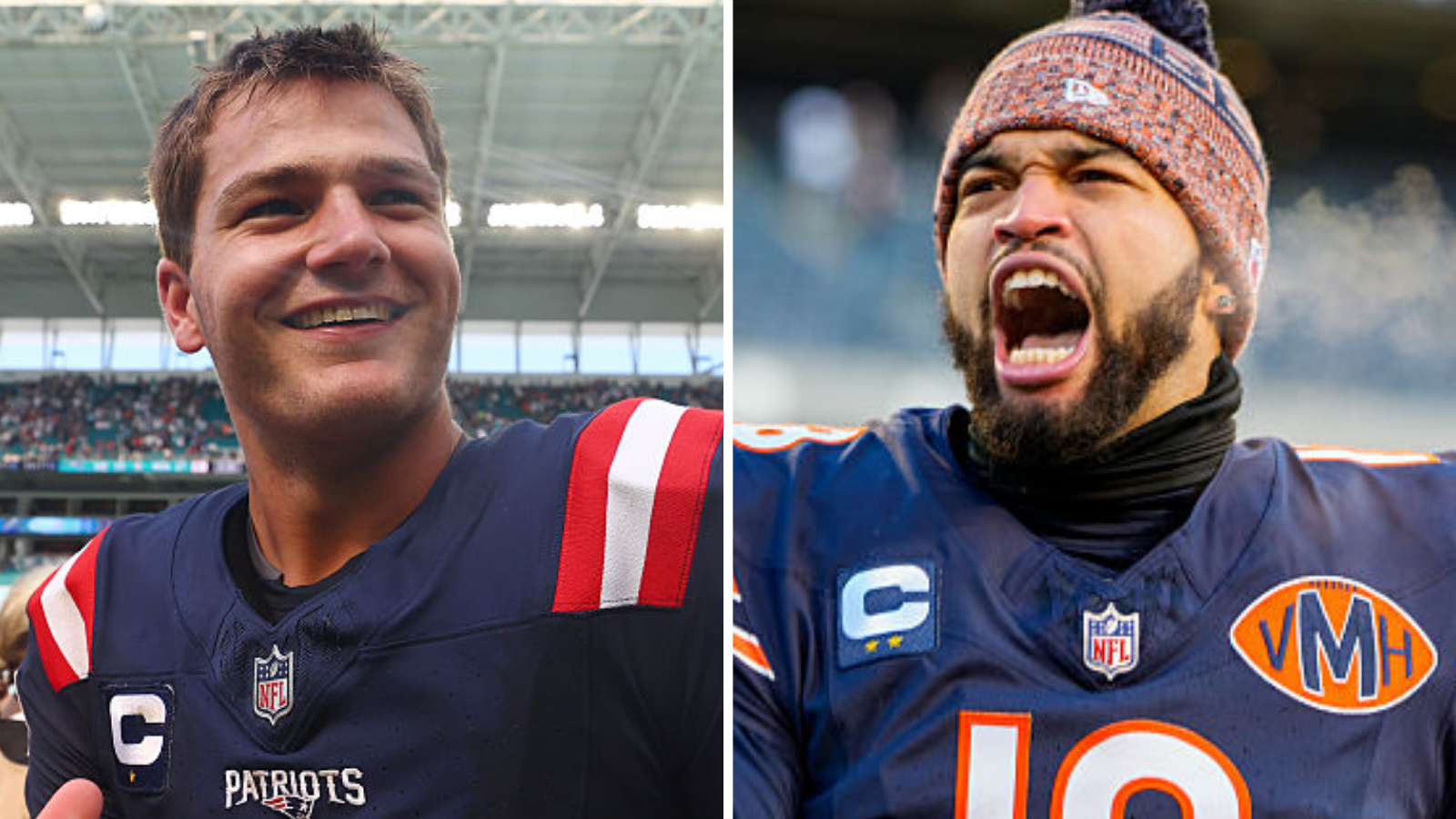
Drake Maye of New England and Chicago's Caleb Williams, both selected early in the 2024 draft
A dynasty has crumbled, established stars have stumbled, and former also-rans have surged into Super Bowl contention.
As noted by experienced analyst Cris Collinsworth, "this is the most unusual year I can remember in the NFL."
Now, 14 teams are poised to compete in the playoffs, and for the first time in 11 seasons, the Kansas City Chiefs are absent.
Last year's champions, the Philadelphia Eagles, have been less formidable, and teams like the Buffalo Bills, tipped for success early on, have not delivered.
Yet, showcasing the competitive balance, 11 playoff qualifiers won 11 or more games, a rarity seen just one other time in the last three-and-a-half decades.
An unprecedented five clubs reached the playoffs following seasons with 11 or more defeats, including New England and Chicago, who each went from last place to first in their divisions.
"If you ask me to pick a favourite, I don't know, because you can put something on all of them," Collinsworth added.
"It's going to be amazing to watch these young quarterbacks go at it because I don't know what they will do. This is when legends begin to be built."
The Mechanics of the NFL Postseason
A field of 14 clubs competes in the playoffs, comprising seven squads from the AFC and seven from the NFC.
Over three weeks and twelve elimination games, the AFC and NFC are kept apart until their champions meet in Super Bowl 60 on February 8.
The highest-seeded team in each matchup enjoys home-field advantage, with the top seeds—Denver and Seattle—receiving a first-round bye during Wildcard Weekend.
These top seeds debut in the Divisional Round. The winners of the subsequent Conference Championships—the de facto Super Bowl semifinals—will clash in the title game at Levi's Stadium in Santa Clara.
A rematch of the 2014 Super Bowl between Seattle and Denver is possible, though Denver later rebounded to win Super Bowl 50 at the same venue in 2016.
The AFC Championship Picture: A Field of Opportunity
A staple of recent playoffs, Patrick Mahomes of the Chiefs, is not participating for the first time in his professional journey.
Adding to the change, Super Bowl 60 will lack both Mahomes and Joe Burrow of Cincinnati, breaking a streak dating back to 2019.
With recent MVPs Mahomes and Lamar Jackson (Baltimore) also out, the AFC playoff field lacks its recent dominant forces, creating a void for new contenders.
This scenario creates a wide-open AFC Championship race, offering a chance for emerging stars like Denver's Bo Nix and New England's Drake Maye to etch their names in playoff lore.
Since 2016, only three franchises have won the AFC Championship, and none of those teams' players from their last title remain.
Denver, despite its high seed, is a playoff novice in recent years, and the Pittsburgh Steelers are the sole other AFC qualifier to have reached a Super Bowl in the past three decades.
However, two veteran AFC quarterbacks with extensive pedigrees—Aaron Rodgers of Pittsburgh and Buffalo's Josh Allen—could use their experience to challenge the newcomers.
Identifying the Frontrunners for the Super Bowl and MVP
The NFC boasts more recent playoff pedigree, with Philadelphia, Los Angeles, or San Francisco appearing in seven of the last eight Super Bowls.
Facing off against Seattle in the brutal NFC West, the Rams and 49ers have already been immersed in a playoff atmosphere for several weeks.
The Seahawks claimed the division crown with a 14-3 mark, riding a seven-game victory streak into the postseason after besting both the Rams and 49ers late.
This earned Seattle the NFC's top seed, making them slight Super Bowl favorites, just ahead of the 12-5 Rams, whose quarterback Matthew Stafford is the MVP frontrunner.
Stafford, who won a Super Bowl in his first season with the Rams in 2022, has never won the MVP but is rated just ahead of New England's second-year quarterback, Drake Maye.
The development of Maye, aided by head coach Mike Vrabel, has been central to the Patriots' remarkable turnaround from four wins to fourteen.
In Chicago, quarterback Caleb Williams has also prospered with a new head coach, Ben Johnson, transforming the Bears into an 11-win team and the NFC's second seed.
The NFL Playoff Kickoff: Wildcard Weekend Matchups
All times are in GMT
Saturday, 10 January
Carolina Panthers host the Los Angeles Rams (21:30)
The Packers visit the Chicago Bears (01:00 Sunday)
Sunday, 11 January
The Bills are on the road against the Jacksonville Jaguars (18:00)
Philadelphia Eagles face the San Francisco 49ers (21:30)
Los Angeles Chargers @ New England Patriots (01:00 Monday)
Monday, 12 January
The Texans meet the Pittsburgh Steelers (01:00 Tuesday)
What to Watch For During the Playoff Openers
Carolina, having secured the NFC South with a poor 8-9 mark, hosts the Los Angeles Rams in the first playoff game, an unusual occurrence.
Although on the road, the Rams feature Matthew Stafford, the regular-season leader in passing yards and TDs, and receiver Puka Nacua, who amassed 1,715 receiving yards.
The Packers, slowed by key injuries, get quarterback Jordan Love back from concussion for a rare playoff meeting in football's longest-standing rivalry.
Despite exceeding expectations by winning the NFC North, Chicago faces pressure to avoid a third consecutive loss and an early playoff exit.
San Francisco, dealing with numerous injuries, must challenge the reigning champion Eagles in Philadelphia, a team that enters well-rested.
Josh Allen and the Bills, often thwarted in recent playoffs, must go on the road to confront a surging Jacksonville squad that has won eight straight.
{New England aims to avoid an upset at home against the Los Angeles Chargers, whose quarterback Justin Herbert seeks his first playoff win in his sixth season.|The Patriots hope to defend their home field against the Chargers, as LA's quarterback Justin Herbert looks for his inaugural postseason victory in year six.|At home, New England tries to stave off the Chargers, with Justin Herbert attempting to secure his first career playoff

